Before committing to an industrial relocation to Northern Nevada, evaluate whether the specific property, workforce, infrastructure, and transition schedule can support your operating plan.
An industrial relocation should improve how a business operates over the period it expects to occupy the facility. That requires a closer evaluation than available square footage or asking rent can provide. Customer access, workforce requirements, infrastructure, approvals, and the cost of moving all affect whether a location supports the business plan. The same questions apply in any market; this article applies them to Northern Nevada.
Through our Northern Nevada relocation campaign, I am meeting with companies to discuss where their next stage of growth belongs. Those conversations can lead to a relocation, an expansion into an additional market, or a decision to remain in place. The useful starting point is the operating problem the company needs to solve.
A recent discussion of Fremont, California's manufacturing ecosystem at Cushman & Wakefield's Industrial Insiders Northwest event reinforced this approach. The city described connecting permitting, infrastructure coordination, and ongoing business engagement. The broader lesson for companies evaluating Northern Nevada is to examine the full path from selecting a property to operating successfully within it.
Northern Nevada at a glance
A Q3 2026 snapshot of Reno alongside the East Bay, Las Vegas, and Phoenix. Reno’s asking rent is about a third below the East Bay’s and roughly 22% below Las Vegas. Vacancy has eased from 14.6% in Q4 2025 to 11.8%, and the higher vacancy gives occupiers more options to compare.
Reno: 11.8% vacancy, $10.08 asking rent, 2.2 million SF year-to-date net absorption (1.8% of inventory)
East Bay (Oakland): 8.4% vacancy, $15.12 asking rent, -2.0 million SF year-to-date net absorption (-1.2% of inventory)
Las Vegas: 9.6% vacancy, $12.96 asking rent, 3.4 million SF year-to-date net absorption (1.9% of inventory)
Phoenix: 10.3% vacancy, $13.56 asking rent, 13.6 million SF year-to-date net absorption (2.4% of inventory)
Source: Cushman & Wakefield MarketBeat Industrial, Q3 2026. Asking rents are per square foot per year, NNN. Net absorption is year-to-date through Q3, shown as a share of market inventory.
Start with the business decision
Define what is prompting the search. A lease expiration is a deadline, but it does not explain the operating objective. The business may need additional production capacity, more efficient distribution, access to a different workforce, or room for equipment that its current facility cannot accommodate.
Separate essential requirements from preferences. A customer service commitment, a specific equipment load, or a required staffing level can determine whether a location is feasible. A preferred office finish usually has more flexibility. Confirming that distinction early keeps the search focused and allows the company to assess renewal, relocation, and expansion on a consistent basis.
Test the location against the network
For a company evaluating Reno, Sparks, or the Tahoe Reno Industrial Center corridor, the question is how the specific address functions within its supply chain. Map the customers, suppliers, carriers, and other facilities that the operation depends on. Then test routes, shipping schedules, and service commitments using the company's actual shipment patterns.
For example, a manufacturer may be able to move finished goods distribution while retaining a production function close to specialized suppliers. A distributor may find that an additional facility improves coverage while a full relocation creates unnecessary disruption. These are different real estate strategies and should be modeled separately.
Evaluate the site as well as the building
Translate the operation into physical requirements. Clear height, loading, floor design, fire protection, and equipment layout need to work together. Employee parking, truck circulation, trailer storage, and any permitted outdoor activities need sufficient space around the building.
Consider how the property will function during a typical shift and at peak activity. A facility with the right floor area can still fall short if staffing needs exceed parking capacity or trucks cannot circulate efficiently. Ask technical advisers to evaluate requirements that depend on engineering, life safety systems, or the proposed production process.
Confirm a credible path to power and utilities
Existing electrical equipment does not establish that the service can support the proposed load. Identify equipment requirements, voltage, demand patterns, and future expansion needs with the company's technical team. Confirm the capacity available to the premises and the process for any additional service with the utility and qualified advisers.
NV Energy's Northern Nevada guidance distinguishes between locations with existing facilities, locations that require new facilities, and requests for temporary power. Its service process also emphasizes complete applications and sufficient notice. The practical implication is to start utility coordination while evaluating a property, rather than assuming it can be resolved after the lease is signed.
Water, wastewater, gas, and telecommunications may also affect suitability. A production process can create requirements beyond those of a conventional warehouse. Document who must complete each improvement, what it depends on, and how the schedule aligns with the company's operating date. For a deeper look at power and utilities, see The Power Readiness Framework: How Electrical Capacity Shapes an Industrial Site Decision.
Validate the workforce plan by role and shift
A regional employment figure cannot establish whether a company can staff its proposed facility. Define the positions required, the relevant skills, shift patterns, recruiting schedule, and training needs. Evaluate compensation and the likely commute to the specific location with current local information.
For a manufacturer, the availability of maintenance technicians or process specialists may be more consequential than the overall size of the labor pool. For a distributor, shift coverage and employee access may be decisive. Include the cost of recruiting and training, and identify which existing employees are expected to transfer.
Regional economic development organizations can help connect businesses with information and resources. Northern NV Now, formerly EDAWN, describes its business attraction role as connecting relocating and expanding companies with sites, data, and regional contacts. Those resources should inform a company specific staffing plan rather than replace one. For a deeper look at the workforce question, see The Labor Readiness Framework: How Workforce Access Shapes an Industrial Site Decision.
Understand approvals before setting the move date
Confirm that the intended activities can be accommodated at the property. An industrial designation alone does not answer every question about a particular use, equipment installation, material, or outdoor activity. Requirements should be checked with the authorities responsible for the specific site.
Establish the likely sequence of use review, design, permits, construction, inspections, and occupancy authorization. Some work may proceed concurrently, while other steps depend on earlier decisions. Track the assumptions behind each estimated date and identify where additional information or agency review is required. Where new construction is under consideration, the build-to-suit versus existing product decision changes this sequence.
Fremont's example is useful because it highlights the value of coordination. For a Northern Nevada project, identify the relevant jurisdiction and contacts early. The process must be understood locally rather than borrowed from another market or municipality.
Model the full cost of the decision
Compare total occupancy cost over the proposed term. Include base rent, operating expenses, improvements, equipment installation, utilities, transportation, staffing, and maintenance responsibilities. Then account for the transition itself: moving equipment, transferring inventory, overlapping facilities, training staff, and managing potential downtime. For the broader case that occupancy cost, not rent alone, should drive the decision, see Industrial Real Estate Is No Longer About Rent.
Separate recurring costs from initial capital requirements. A location that improves the annual operating budget may still require a substantial cash commitment before opening. Leadership needs to see when those costs occur, which assumptions drive the result, and how delays would affect the recommendation.
Where incentives may apply, establish eligibility, timing, approval requirements, and ongoing obligations with the appropriate agencies and advisers. Model the decision without assuming an award. Any confirmed benefit can then be incorporated with its actual conditions.
Build the transition schedule backward from operations
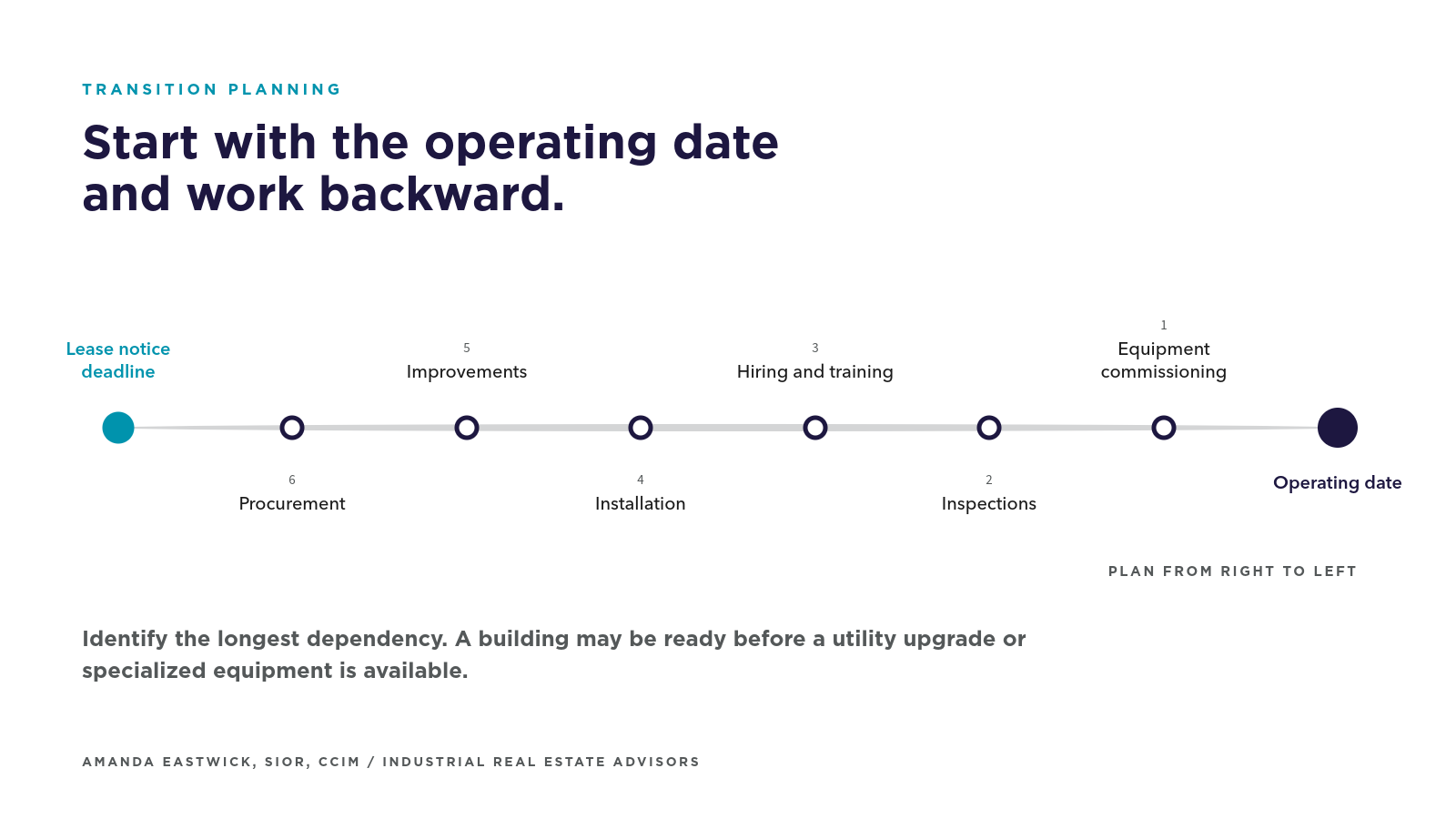
The move is complete when the business can operate as required. Start with that date and work backward through equipment commissioning, inspections, hiring, installation, improvements, and procurement. Coordinate the new facility schedule with the existing lease obligations and any notice deadlines. For more on why that clock starts earlier than most companies expect, see Why Most Companies Start Their Industrial Lease Renewal Too Late.
Identify the longest dependency and the alternatives if it slips. A building may be ready before a utility upgrade or specialized equipment is available. A phased opening may be possible, but its operating limits and cost need to be evaluated rather than assumed.
Use the same discipline when negotiating delivery responsibilities and remedies. The real estate agreement should reflect the business schedule and the risks the parties have identified, with legal counsel addressing the appropriate provisions.
Preserve room for the next stage of growth
Evaluate what happens after the initial move. Can staffing increase within the available parking? Can another production line be added? Is expansion physically possible, and can any required rights be negotiated? How would an equipment change affect utility requirements?
These questions help establish how long the facility can reasonably serve the company. They also reveal when an additional site, a different layout, or greater flexibility in the agreement may be more valuable than space the business does not yet need.
Turn the evaluation into a location strategy
The purpose of our Northern Nevada relocation campaign is to open a substantive conversation about whether the region supports a company's next business decision. That requires a clear understanding of the operation and a property evaluation grounded in local execution requirements.
My role as an industrial occupier adviser is to connect those requirements to real estate options, bring the relevant parties into the process, and help the company evaluate the tradeoffs. The result should be a recommendation leadership can assess against cost, timing, and operating performance.
For companies considering Northern Nevada, a useful first conversation begins with the facility's role in the business, the requirements it must meet, and the date the operation needs to be ready. Those answers create the basis for a location decision that can be tested before capital and commitments are made.
Frequently asked questions
What should a company evaluate first?
Start with the operating objective behind the move: the capacity, distribution, workforce, or equipment that the current facility cannot support. Then separate essential requirements from preferences and test each location against them.
How early should relocation planning begin?
Early enough that lease notice deadlines do not force the decision. Utility coordination, approvals, hiring, and equipment commissioning can take longer than the property search, so build the schedule backward from the date the operation must be ready.
How do we confirm sufficient power?
Define the load, voltage, demand pattern, and expansion needs with your technical team, then confirm the available capacity and the service process with the utility before signing. Existing electrical equipment does not establish that the service can support the proposed load.
When does expansion make more sense than a full relocation?
When the current operation still serves a purpose, such as proximity to specialized suppliers, and the real constraint is capacity or coverage. A manufacturer may move finished goods distribution while keeping production in place, and a distributor may add a facility instead of relocating. Model each strategy separately.
Considering Northern Nevada or another Western market?
If your company is evaluating a relocation, an expansion, or a new warehouse or manufacturing location, request a Cushman & Wakefield relocation roadmap to start the conversation, or contact me directly to talk through your operating requirements first.
Sources and further reading
Event discussion: The Fremont Formula, Industrial Insiders Northwest, October 2026. Event observations are paraphrased from attendance and meeting notes.
NV Energy Northern Nevada electric service guidance
NV Energy existing service process
Amanda Eastwick, SIOR, CCIM, is a Director at Cushman & Wakefield and an Industrial Advisor specializing in occupier strategy, site selection, and lease negotiation across the Western U.S. She is the Founder and President of WILD, Women in Industrial, Logistics & Development. BS.146113