Industrial Lease Negotiations: Where Occupiers Take On More Risk Than They Realize
The short answer: In an industrial lease negotiation, the rental rate is only part of the cost. The lease terms decide who pays when a roof, HVAC system or electrical service falls short, what condition the building is delivered in, which operating expenses pass through to the tenant, and how much flexibility the company keeps if its needs change. Evaluate price and risk together before the economics are final.
The rental rate tells you what the space costs. The lease terms help determine what the operation could cost.
When industrial occupiers evaluate a lease, the economics naturally command attention. What is the asking rate? What are the annual increases? What are the operating expenses? What tenant improvement dollars or concessions are available?
Those questions matter. But they do not tell you whether the lease is a good deal.
Some of the most consequential economics in an industrial transaction are buried deeper in the business terms: who is responsible when a major building system fails, what condition the building must be in at delivery, whether the electrical infrastructure can actually support the operation, what costs can be passed through to the tenant, and how much flexibility the company retains if its needs change.
In other words, I am not only looking at what an occupier will pay. I am looking at where the risk went.
That distinction matters because an industrial facility is not simply an expense on a lease abstract. It is part of the operating infrastructure of the business. A lease can look attractive on paper and still place significant cost, responsibility, or operational risk on the tenant.
Start With the Operation, Not the Lease Form
Before evaluating individual lease provisions, I want to understand how the company will actually use the building.
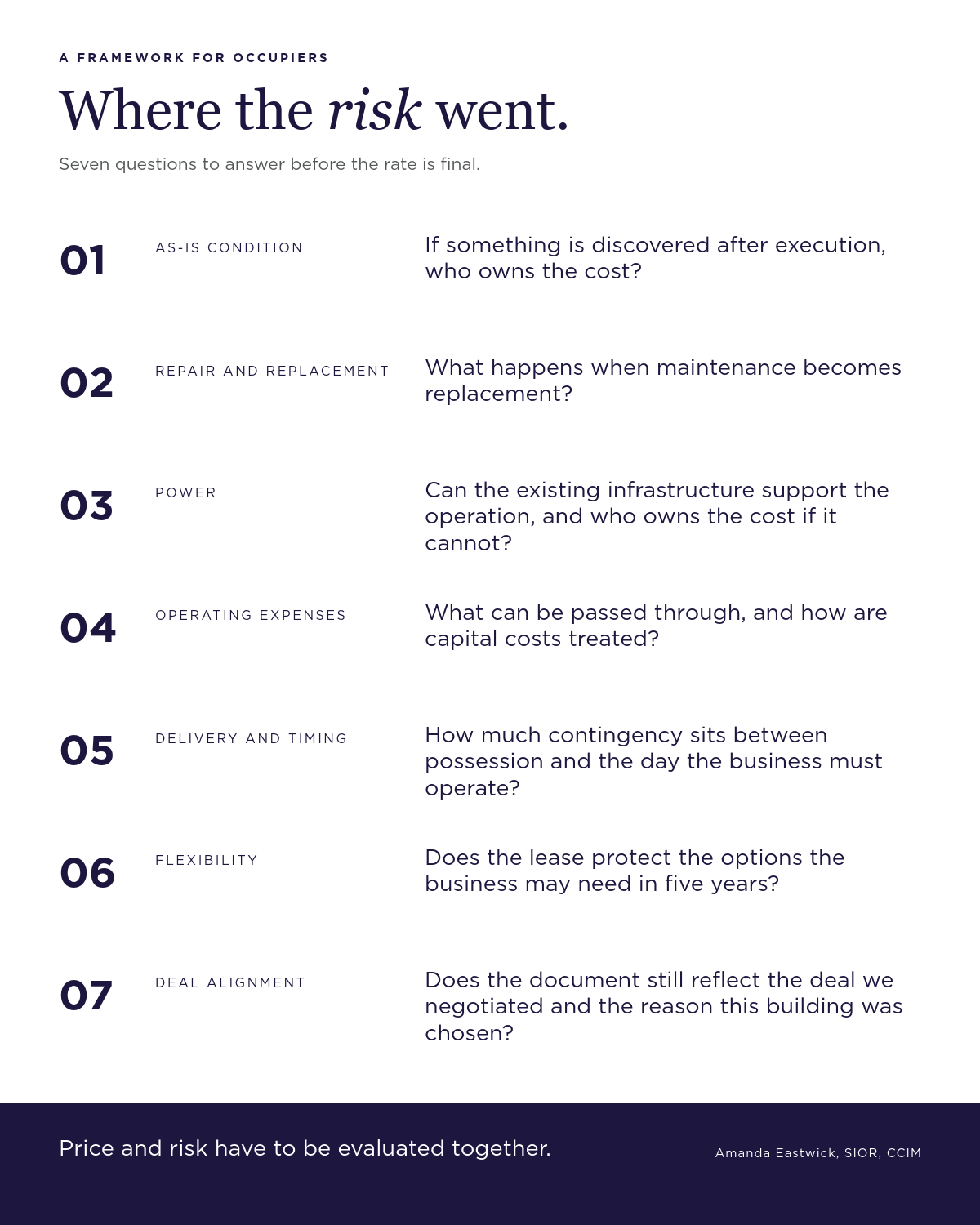
Where the risk went: seven questions to answer before the industrial lease rate is final.
What does the operation require from the facility? Which building systems are mission-critical? What would create meaningful downtime? How much flexibility does the business need? What capital is the company willing to invest in someone else’s building? How long does it expect to occupy the facility?
Those answers change the significance of the lease terms. A provision that may be relatively inconsequential for one occupier can create material exposure for another.
The condition of an HVAC system has a different operational significance in a basic warehouse than it does in a facility with temperature-sensitive processes. Electrical capacity can be a relatively simple consideration for one user and a fundamental site-selection requirement for another.
The business requirement determines which risks matter most.
What “As-Is” Really Means in an Industrial Lease
One phrase I pay close attention to in an industrial transaction is “as-is.”
It can sound straightforward. The tenant has toured the building. Everyone understands that it is existing product. The economics may even appear to account for the condition. But “as-is” should trigger another set of questions.
What is the actual condition of the roof? What is the remaining useful life of the HVAC equipment? Are the dock doors and equipment operational? Are the electrical systems adequate for the tenant’s intended use? Are there deferred maintenance items? What work, if any, will the landlord complete before possession? And if something is discovered after execution, who owns the cost?
Example: How a Lower Rate Can Hide Roof Exposure
Consider a simplified example. A tenant leases 90,000 SF in a 350,000-SF building offered as-is at $0.05 per SF per month below the alternatives. That difference represents $54,000 per year, or $378,000 over a seven-year term.
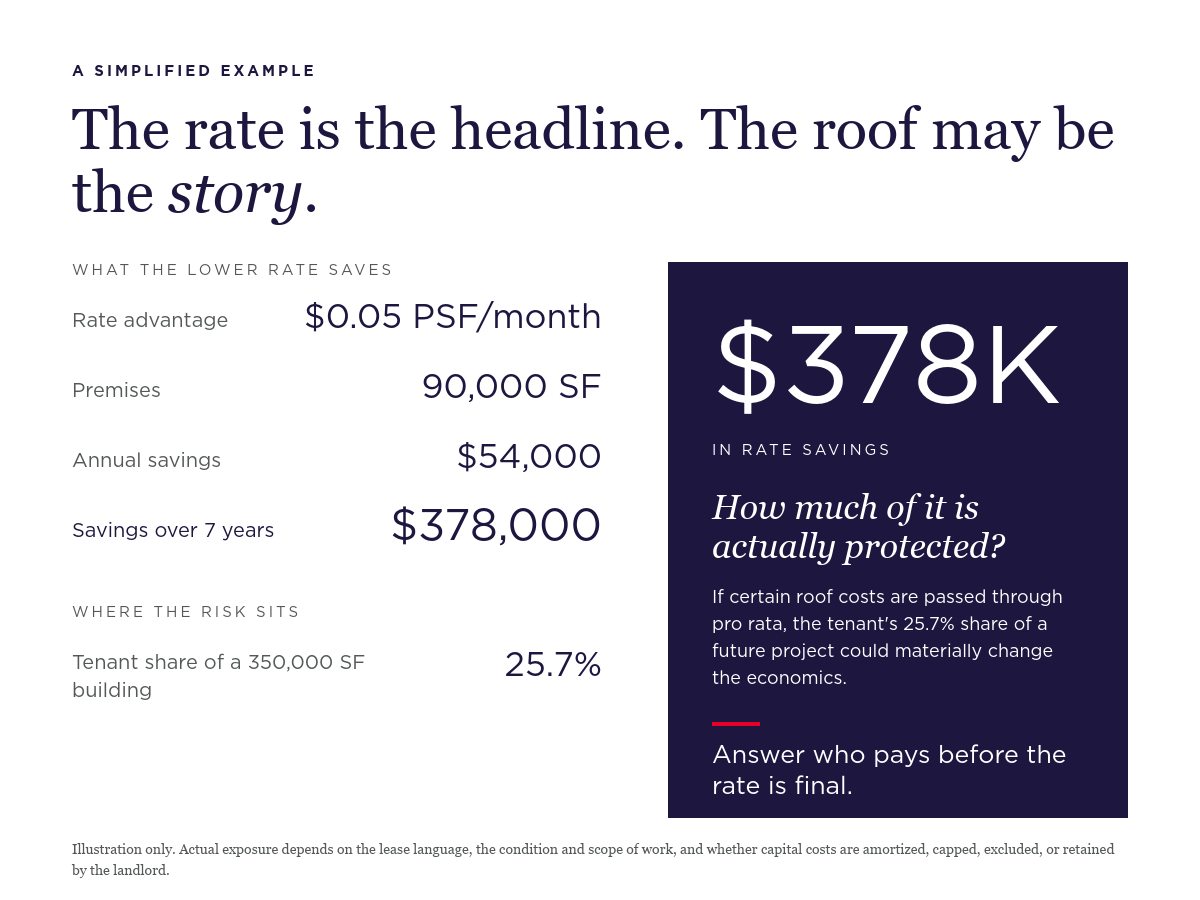
The rate is the headline. The roof may be the story.
If the lease allows certain roof costs to be passed through to tenants on a pro rata basis, this tenant represents roughly 26% of the building. Depending on the age and condition of the roof, the scope of work required, and how those costs are treated under the lease, the tenant’s potential exposure could materially reduce the savings created by the lower rental rate.
Roof restoration costs can vary significantly based on the existing system, age, condition, building size, required repairs, and whether the work involves restoration or replacement. The point is not to predict the roofing bill before a contractor evaluates it. The point is to identify who may ultimately be responsible for it before the tenant commits to the economics.
Not every lease works this way. Some roof work remains a landlord responsibility. Other structures may allow certain capital costs to be amortized or passed through subject to negotiated limitations. Which structure you have is the question to answer before the rate is final.
The objective is not necessarily to eliminate every tenant responsibility. In many industrial transactions, tenants appropriately assume meaningful responsibility for the facility. The objective is to understand what is being accepted before the economics are finalized.
A lower rental rate can make sense in exchange for greater responsibility. But that should be a deliberate business decision, not something the occupier discovers after the lease is signed.
How Repair and Maintenance Obligations Change Industrial Lease Economics
Industrial buildings work hard. Roofs, HVAC units, dock equipment, paving, plumbing, fire protection systems, and other building components all have maintenance requirements and useful lives.
The question is not simply whether the lease says “tenant maintains” or “landlord maintains.” The more important business questions are: What exactly is included? What is excluded? And what happens when maintenance becomes replacement?
An occupier comparing two facilities may see a meaningful difference in rental rate. But if the lower-cost alternative also transfers significantly more repair or replacement responsibility to the tenant, the apparent savings deserve a closer look.
Price and risk have to be evaluated together.
Does the Building Have the Electrical Power Your Operation Needs?
A building can have electrical service without having the electrical capacity, configuration, or infrastructure required by a specific operation. For power-intensive occupiers, that distinction matters.
What does the equipment load actually require? What service exists today? Is the existing infrastructure adequate for the intended operation? If upgrades are required, who is responsible for them? What is the anticipated cost and timeline? What needs to happen before the tenant can actually begin operating?
The answers depend on the user, the load, the existing infrastructure, and the utility. That is precisely why these questions need to surface early enough to influence site selection and the business terms, not after the lease is signed.
If power is critical to the business, it cannot remain a vague property feature. It becomes part of the transaction strategy.
Industrial Operating Expenses: Know What Passes Through to the Tenant
In many industrial leases, the tenant pays some combination of taxes, insurance, common-area expenses, maintenance, and other property-level costs in addition to base rent (often described as NNN). That makes the operating-expense structure an important part of the economics.
What expenses can be passed through? How are they calculated? How are capital expenditures treated? Are there administrative or management charges? Are there negotiated exclusions or limitations? What do historical expenses tell us about how the structure has performed in practice?
The answers affect the occupier’s actual cost of occupancy over the term. This is not about assuming that every pass-through is unreasonable. Different lease structures allocate costs differently. The objective is to understand the economic structure the occupier is agreeing to, not only the number printed next to base rent.
Delivery Conditions and Timing: Lease Commencement vs. Operational Start
A lease commencement date and an operational start date are not necessarily the same thing. This becomes particularly important when a landlord is completing work, the tenant has improvements to install, equipment needs to be moved, permits are required, or utilities need to be upgraded.
When will the building be delivered, and in what condition? What work must be completed before the tenant can begin its improvements? What happens if landlord work is delayed? When does rent commence?
And perhaps most importantly: How much contingency exists between possession and the date the business actually needs to operate?
A date on a lease can look precise while the underlying execution plan remains anything but. For an industrial occupier, timing risk can quickly become operating risk.
Lease Flexibility: Renewal, Expansion, Assignment and Subletting Rights
Not every important lease term affects today’s occupancy cost. Some protect tomorrow’s options: renewal rights, expansion opportunities, assignment and subletting provisions, contraction rights where available, permitted-use language, alteration rights, and restoration obligations.
An occupier may grow faster than expected. A business unit may be sold. Distribution strategy may change. Automation may alter the facility requirement. The company may need additional power or a different building configuration. A location that makes sense today may not make sense five years from now.
No lease can eliminate uncertainty. But a well-structured transaction can avoid creating unnecessary constraints.
Flexibility is difficult to value when you do not need it. It becomes very easy to value when you do.
Tenant Broker vs. Real Estate Attorney: Who Reviews What in an Industrial Lease
Industrial lease negotiations are a team effort. Experienced real estate counsel is essential for interpreting legal language, documenting rights and obligations, and advising the client on legal risk.
My role as an occupier advisor is different. I am looking at the lease through the operation and through the business deal we negotiated.
Does the document reflect the economics we agreed to? Does the delivery condition support the operational timeline? Are the responsibilities consistent with the assumptions we used to compare the building against alternatives? Does the tenant retain the flexibility the business told us it needed? Have we introduced an obligation that materially changes the economics of the transaction?
And ultimately, does the final structure still support the reason we selected this facility in the first place?
Those questions sit at the intersection of real estate and business strategy. That is where tenant representation should add value.
A Good Industrial Lease Supports More Than Today’s Transaction
Industrial lease negotiation is not about shifting every possible obligation to the landlord. It is about understanding the tradeoffs.
A tenant may intentionally accept additional responsibility in exchange for better economics. It may invest significant capital because a facility provides an unusual operational advantage. It may accept less flexibility because the location is strategically important and the company expects to remain there long term. Those can all be rational decisions. But they should be intentional decisions.
The rental rate tells you part of the story. The rest is found in the responsibilities, assumptions, protections, and flexibility that determine how the building will actually function for the business over time.
Before an industrial occupier signs a lease, I believe there is one question worth asking one more time:
Do the terms of this transaction support the way we intend to operate, or have we simply negotiated a good price for the space?
There is a meaningful difference.
Frequently Asked Questions About Industrial Lease Negotiation
What does “as-is” mean in an industrial lease?
“As-is” means the tenant accepts the building in its existing condition, but it does not settle who pays if a system fails after signing. Before agreeing, confirm the condition and remaining life of the roof, HVAC, dock equipment and electrical, what the landlord will complete before possession, and who owns costs discovered later.
Who pays for a roof replacement in an industrial lease?
It depends on the lease. Some roof work stays with the landlord, while other leases allow certain capital costs to be amortized or passed through to tenants pro rata, subject to negotiated limits. Identify which structure applies before the rental rate is final, and have counsel review the language.
What should an industrial tenant look at besides the rental rate?
Look at repair and replacement responsibility, delivery condition, electrical capacity, operating-expense pass-throughs, timing from possession to operations, and flexibility such as renewal, expansion, assignment and subletting rights. Price and risk should be evaluated together.
How do I know if a warehouse has enough power for my operation?
Electrical service existing does not mean it fits your load. Compare your equipment requirements to the existing service and infrastructure, find out who pays for any upgrade, and understand the cost and timeline with the utility before the lease is signed.
What is the difference between lease commencement and operational start?
Commencement is when the lease and rent obligations begin. Operational start is when the business can actually run, which may depend on landlord work, permits, utility upgrades and tenant improvements. Build contingency between possession and the date you need to operate.
What is a tenant representative’s role compared to a real estate attorney?
Counsel interprets the legal language, documents rights and obligations, and advises on legal risk. A tenant advisor checks that the lease reflects the negotiated economics, supports the operational timeline, and preserves the flexibility the business needs.
Evaluating an industrial lease?
The economics are only part of the decision. If you are evaluating a renewal, relocation, or new industrial lease and want to understand how the terms affect your operation, cost, and flexibility, connect with Amanda Eastwick, SIOR, CCIM to discuss your requirement.
Amanda Eastwick, SIOR, CCIM, is a Director at Cushman & Wakefield and an Industrial Advisor specializing in occupier strategy, site selection, and lease negotiation across the Western U.S. She is the Founder and President of WILD, Women in Industrial, Logistics & Development. BS.146113
industrialrealestateadvisors.net
This article is general information and not legal advice. Consult qualified real estate counsel on lease language.