How Industrial Tenants Should Think About Lease Timing in 2026
Industrial lease decisions are rarely driven by real estate alone. They are driven by timing, operational trajectory, and capital strategy.
Across Western markets such as Reno, Phoenix, and Northern California, industrial conditions continue to recalibrate. Vacancy headlines suggest flexibility in certain segments. Concessions remain present in select size ranges. At the same time, sublease inventory is contracting and high functioning buildings are absorbing quietly.
The primary risk is not selecting the wrong building.
The primary risk is waiting too long to preserve leverage.
When evaluation begins late in the lease cycle, optionality narrows. Competitive alternatives diminish. Construction timelines become impractical. Expansion flexibility disappears. The landlord understands that relocation is no longer feasible. At that stage, negotiation becomes reactive rather than strategic.
Recently, a client reflected on this dynamic:
“We assumed we were simply deciding whether to renew. What we did not realize was how much negotiating strength we had until we began evaluating options early.”
Leverage exists only when credible alternatives exist. Alternatives require time.
A Structured Framework for Renewal Versus Relocation
Renewal and relocation should not be treated as binary real estate choices. They are capital allocation decisions that affect operational performance, labor efficiency, and long term growth capacity.
Three strategic filters bring clarity to this evaluation.
Operational Alignment
The first consideration is whether the current facility supports the next phase of the business, not merely present day operations.
Clear height, dock configuration, yard depth, trailer storage, and power capacity all influence throughput and labor productivity. A building that once aligned perfectly may gradually create inefficiencies as automation increases, volumes expand, or distribution models shift.
Western markets increasingly demonstrate a separation between commodity inventory and high performance logistics assets. Overall vacancy may appear available. However, buildings configured for modern operational requirements remain limited in specific size categories.
If facility constraints are increasing labor cost, limiting automation, or restricting growth, renewal should not be automatic.
Financial Positioning
The second filter requires disciplined financial modeling.
Market rent comparisons provide only a partial view. A comprehensive analysis includes tenant improvement allowances, free rent, capital expenditures, relocation costs, downtime risk, and the long term cost of operational inefficiency.
In certain Western secondary markets, early engagement continues to generate negotiating leverage. However, that leverage diminishes rapidly as expiration approaches.
In some circumstances, renewal captures concessions and preserves operational continuity. In others, relocation produces measurable efficiency gains that offset moving costs within a defined horizon.
The correct path emerges only when both scenarios are modeled objectively.
Strategic Optionality
The third and often overlooked dimension is strategic optionality.
For Western occupiers, the question is not simply whether to remain in place or move across town. It may involve evaluating labor availability in Reno versus Phoenix. It may involve analyzing proximity to ports, intermodal corridors, or key customer concentrations. It may involve tax structure considerations or long term expansion sequencing.
Even when a tenant ultimately renews in its current market, evaluating credible multi market alternatives strengthens clarity and negotiation posture. Understanding broader regional dynamics allows leadership to make occupancy decisions aligned with supply chain strategy rather than short term convenience.
Renewal can be strategic. Relocation can be strategic. Both require a multi market lens when growth, labor access, and infrastructure are central to the business model.
Timing as the Primary Lever
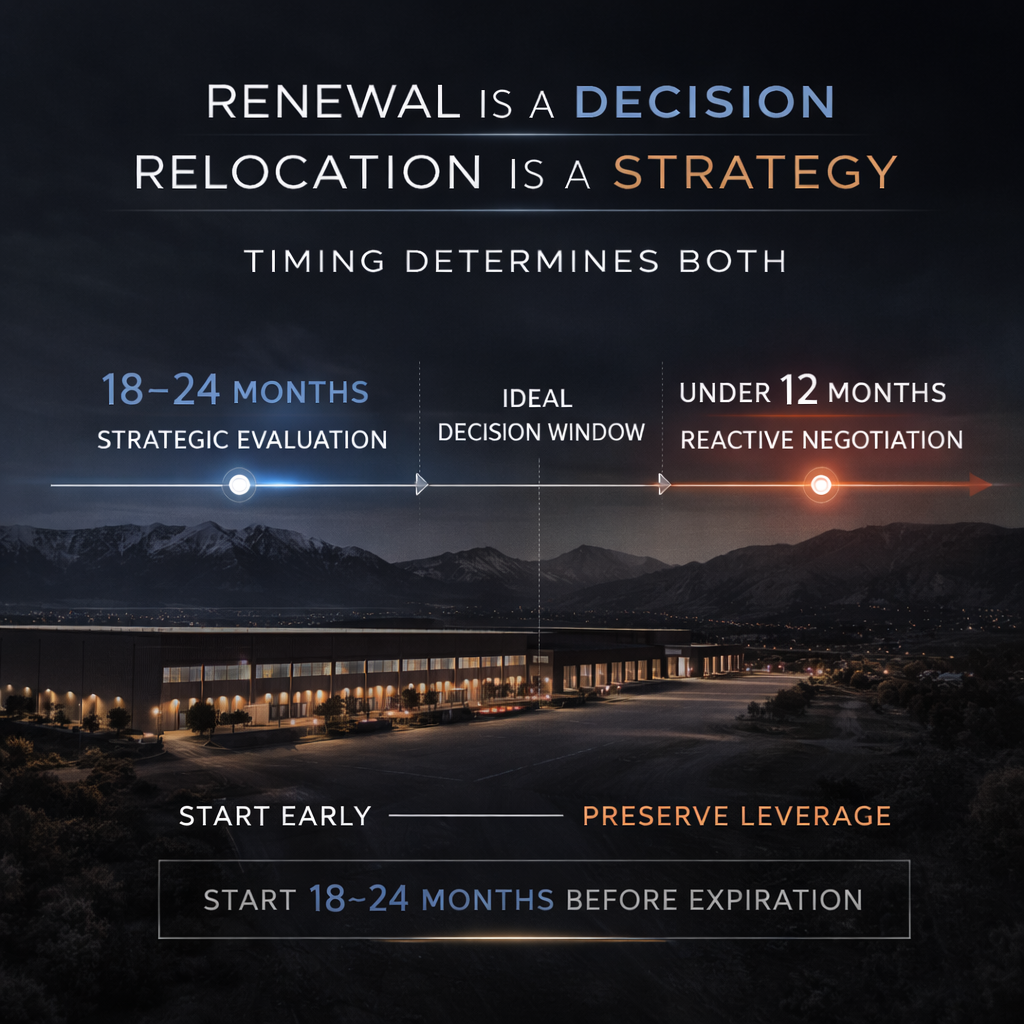
The most strategic renewals begin well before a renewal notice is required. The most strategic relocations begin before relocation feels urgent.
Initiating evaluation eighteen to twenty four months prior to expiration provides the necessary runway to analyze alternatives, tour competitively, model capital deployment accurately, and introduce appropriate competitive tension.
When timelines compress, leverage erodes. When evaluation begins early, optionality expands.
Lease timing should be approached as risk management. It protects capital, preserves negotiating strength, and aligns facility decisions with long term operational objectives.
A Western Market Decision Matrix
For occupiers operating across the Western United States, renewal versus relocation should be evaluated within a broader regional framework rather than as a single market event.
Each Western market is evolving differently, influenced not only by distribution demand but also by manufacturing investment, infrastructure expansion, and sector specific capital flows.
Reno, Boise, and Portland are increasingly positioned to capture growth in light and mid scale manufacturing. Competitive occupancy costs, available industrial land, and proximity to major West Coast consumption corridors create an environment conducive to fabrication, assembly, and specialized production. For occupiers evaluating operational resilience or partial reshoring strategies, these markets offer scalable alternatives with structural advantages.
Phoenix and Northern California are seeing momentum in advanced manufacturing sectors including semiconductors, clean technology, and high precision fabrication. Public and private capital investment in these industries is reshaping submarket demand for power capacity, building specifications, and workforce specialization. For companies aligned with technology driven production or supply chain integration into semiconductor ecosystems, location strategy carries long term infrastructure implications.
Las Vegas, along with Phoenix, continues to strengthen its position as a bulk distribution node serving Southern California consumption. Proximity to major population centers combined with relative cost advantages has increased its attractiveness for large format logistics operations seeking regional reach without coastal occupancy premiums.
These markets are not interchangeable. They serve distinct operational strategies.
A renewal decision in Reno should be informed by how manufacturing growth trajectories in Boise or Portland may influence labor competition. A distribution operator in Phoenix should evaluate how bulk capacity in Las Vegas affects long term network design. An advanced manufacturing occupier in Northern California must consider power infrastructure and talent concentration over a multi year horizon.
Even when a tenant ultimately renews in its current location, evaluating credible multi market alternatives strengthens clarity and negotiation posture.
The objective is not relocation for its own sake.
The objective is alignment between facility configuration, labor access, capital deployment, and long term enterprise strategy across the Western corridor.
In Closing
If a lease expires within the next twenty-four months, the analytical process should already be underway.
Renewal versus relocation is not a question of preference. It is a structured evaluation of labor availability, power capacity, transportation access, infrastructure durability, and long-term scalability.
Labor depth determines operational resilience. Power infrastructure determines manufacturing feasibility and automation potential. Transportation networks determine delivery velocity and supply chain reliability. Building configuration determines throughput efficiency. Capital structure determines long-term occupancy cost.
These variables extend beyond a single property. They define enterprise performance.
A disciplined evaluation models both renewal and relocation within this broader framework. It considers not only immediate rent economics, but also labor competition, utility constraints, infrastructure investment, and network design across the Western corridor.
Even when renewal is selected, it should be chosen from a position of data, comparative analysis, and preserved leverage.
In industrial real estate, timing protects optionality. Analytical preparation protects capital.
Strategic occupancy decisions are not reactive events. They are infrastructure decisions that shape the next decade of operational performance.
A Disciplined Evaluation Approach
For occupiers approaching lease expiration within the next twenty-four months, renewal versus relocation should be evaluated through a structured and scalable review process.
The scope of analysis will vary based on the organization’s operational complexity, growth trajectory, and geographic footprint. In some cases, the evaluation may center on financial modeling and lease economics. In others, it may require deeper review of labor dynamics, power capacity, infrastructure investment, or transportation network design across multiple Western markets.
The objective is not to generate unnecessary analysis. The objective is to ensure that the decision is informed by data, aligned with enterprise strategy, and supported by preserved leverage.
When evaluation begins early and is calibrated to the business rather than the calendar, leadership retains optionality and protects long term performance.
Broker | Industrial Specialist
Cushman & Wakefield – Northern Nevada
NV License # BS.146113
📍 Clear heights, concrete, and dock doors are my love language.
The views expressed in this blog are my own and do not necessarily reflect those of Cushman & Wakefield.