The Labor Readiness Framework: How Workforce Access Shapes an Industrial Site Decision
Something has quietly shifted in how industrial site selection gets sequenced. As power, land configuration, and permitting have moved to the front of the process, labor has been pushed back in the order of operations. Area Development’s 2026 series on the new rules of industrial site selection put it directly, describing workforce as no longer the first filter, and in a narrow sense that is accurate: a site that cannot be powered or permitted will not survive long enough for a labor conversation to matter. But that sequencing change is being widely misread as a change in importance, and it is not. Power decides whether a site is possible. Labor decides whether the operation inside it actually runs.
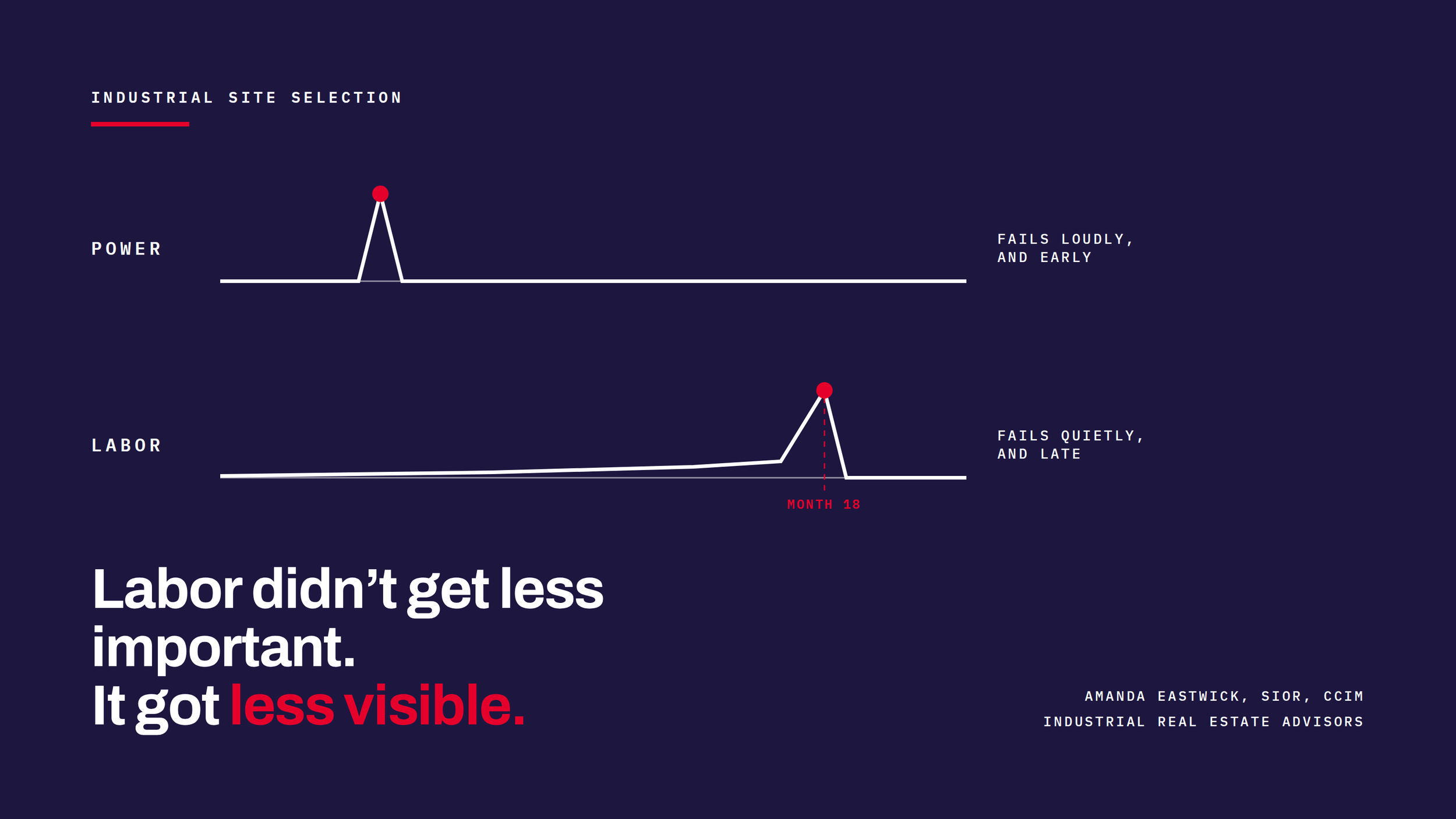
That distinction matters because the two variables fail differently. A power problem announces itself. It shows up as a utility timeline, an upgrade estimate, a substation constraint, something with a number attached that a project team can see and price. A labor problem does not announce itself at all. It shows up eighteen months after occupancy, as a second shift that never fully staffs, a turnover rate that quietly resets the hiring clock every quarter, and a productivity assumption in the original business case that was never achievable at that location in the first place. By then the lease is signed, the equipment is installed, and the real estate decision has stopped being reversible.
So the question is not whether a market has workers. Most markets have workers. The better question is whether this specific site can recruit and retain the specific workforce this operation requires, at a wage the business case supports, on the shifts the operation actually runs. That is a real estate question, not only an HR question, and it deserves to be evaluated on the same footing as power, rent, and transportation rather than confirmed after a building has already been chosen.
START WITH THE SHIFT, NOT THE MARKET
Every labor conversation that starts with a market is starting in the wrong place. Regional employment figures describe an economy. They do not describe whether your operation can staff a Sunday night shift twelve minutes farther from the population center than the building you passed on. That starting point comes from the operation, not from a market report.
An operations leader or plant manager typically already knows, or can quickly assemble, the pieces that matter: how many people the facility needs at full run rate, and how many on day one; what the shift structure looks like, including whether the operation requires nights, weekends, or continuous coverage; which roles are genuinely interchangeable and which require certification, licensure, or experience that takes months to replace; what seasonality does to headcount, and how far above baseline peak actually goes; and what the operation can absorb in wage terms before the location stops making sense.
That last point is where most labor analysis quietly breaks down. A wage requirement is a band, not a figure, and the top of that band, the wage at which the site still works financially, is what determines whether a labor market is accessible to you or merely nearby.
The output of this step is not a staffing plan. It is a clear, business-language description of the workforce the site needs to support, developed before anyone tours a building or compares a market.
PRACTICAL LABOR VOCABULARY, FOR DECISION-MAKERS RATHER THAN ECONOMISTS
An occupier does not need to become a labor economist to make a good real estate decision. They need enough fluency to know what has to be verified, and by whom, before a site is trusted. A handful of terms come up constantly in these conversations, and the purpose of understanding them is not to reduce labor readiness to a single score. It is to know when an answer is incomplete.
The most important of them is the labor shed, which is the geography workers will actually commute from to reach a specific site, measured in drive time rather than distance. It is not the same thing as the metro area the building sits in, and it is site-specific rather than market-specific. Two buildings in the same submarket can draw from materially different labor sheds, which makes this one of the very few workforce variables that is genuinely and entirely a real estate variable.
The rest describe the pool itself, and they matter in combination rather than alone. Labor force participation describes what share of the working-age population is employed or actively looking, and in a site search it reads differently than it does in an economic report: a high rate means the slack has already been absorbed. Worker concentration, sometimes discussed as a location quotient, describes how heavily a region is already staffed in an occupation relative to a baseline, while target demographic concentration describes the underlying population those roles are recruited from. That pairing is the comparison most commonly skipped, and it tells you more than either figure does alone. Effective wage is the fully loaded cost of a worker, meaning the posted rate plus shift differentials, overtime driven by understaffing, recruiting spend, and turnover; two markets with identical posted wages can carry very different effective wages, and the gap is usually a turnover story. Applicant flow is how many qualified people actually apply per open role per week at the wage you intend to offer. It is the most decision-relevant labor number in a site search, and it appears in almost no published report.
No single figure on a market summary answers whether a site works. The purpose of this vocabulary is to recognize when an answer is incomplete, so the right verification gets requested before a decision is made rather than after.
“LABOR AVAILABLE” VS. “LABOR ACCESSIBLE”
This is the central distinction in how we evaluate workforce on a site, and it is the direct parallel to the distinction between power available in a market and power deliverable to a building. It deserves to be stated plainly, because it is where most expensive labor mistakes in industrial site selection actually originate.
A market summary reporting a large industrial workforce is not labor due diligence. It is a starting point for due diligence, nothing more. Three separate claims tend to get collapsed into one, and each requires its own verification.
The first claim is that the region has the workers. This is the easiest to confirm and the least useful on its own. Published employment volumes describe who is working in an occupation today. They do not describe who is available to work for you.
The second claim is that those workers are reachable from this site. Regional totals are drawn across an entire metro. Your building draws from a drive-time radius around one address. A site on the wrong side of a river, a pass, a toll, or a congested interchange can sit inside a large labor market and outside most of it, and no market-level figure will surface that.
The third claim, and the one that decides outcomes, is that those workers will take your job, at your wage, on your shift. This is where availability and accessibility separate completely. In a market where participation is already high and existing employers are already absorbing the qualified population, new entrants are not hiring from a pool. They are recruiting against incumbents, which is a fundamentally different exercise with a different cost structure and a much longer ramp.
Before we eliminate sites on economics or layout, we want these three questions answered separately, by the parties actually positioned to answer them, rather than inferred from a single regional number.
WHAT THIS LOOKS LIKE IN A REAL MARKET
Northern Nevada is a useful place to test that distinction, partly because we work here and partly because it looks straightforward until you read the numbers in pairs rather than one at a time.
Cushman & Wakefield’s West Region Industrial Labor Report for the fourth quarter of 2025 puts Reno’s warehouse wage index at 107 against a U.S. baseline of 100 and a West regional average of 112, and shows above-average concentrations of material-moving workers at 1.5 against a West regional 1.2, and production workers at 1.1 against 0.9. Read on their own, those are two strengths: wages below the Western average, and a deep, established industrial labor base. Both are real.
The number that changes the interpretation is the underlying target blue-collar demographic concentration, which the same report puts at 0.9, below both the West and the national baseline, against a labor force participation rate of 87.7 percent that exceeds the West at 85.1 percent and the U.S. at 84.4 percent.
Put together, those figures describe a market that is employing an unusually high share of a comparatively thin underlying population in industrial work, with very little participation slack left to draw on. That is not an argument against Northern Nevada, and we would not make one. The region’s fundamentals are strong, the industrial labor base is genuinely established, and material-moving and production employment are both projected to grow. It is an argument that in this market, more than in a market with visible slack, an occupier’s headcount will likely come from recruiting rather than from absorption, and that assumption belongs in the business case before a site is selected rather than after.
This is also one of the few markets where the labor shed argument can be made concrete rather than theoretical, because the work-location and residence-location data visibly diverge. Lightcast data compiled for Washoe County, drawn from employment by ZIP code as of 2022, shows the ZIP codes where people work alongside the ZIP codes where those workers live, and they are not the same places. The 89502 ZIP in Reno holds roughly 46,700 jobs against about 25,000 resident workers. The 89431 ZIP in Sparks holds roughly 35,500 jobs against about 21,400 resident workers. Both are substantial net importers of labor. Meanwhile 89436, covering Sparks and Spanish Springs, is the largest residential concentration of workers in the county at roughly 25,300, and does not appear among the top employment ZIPs at all. It is a net exporter.
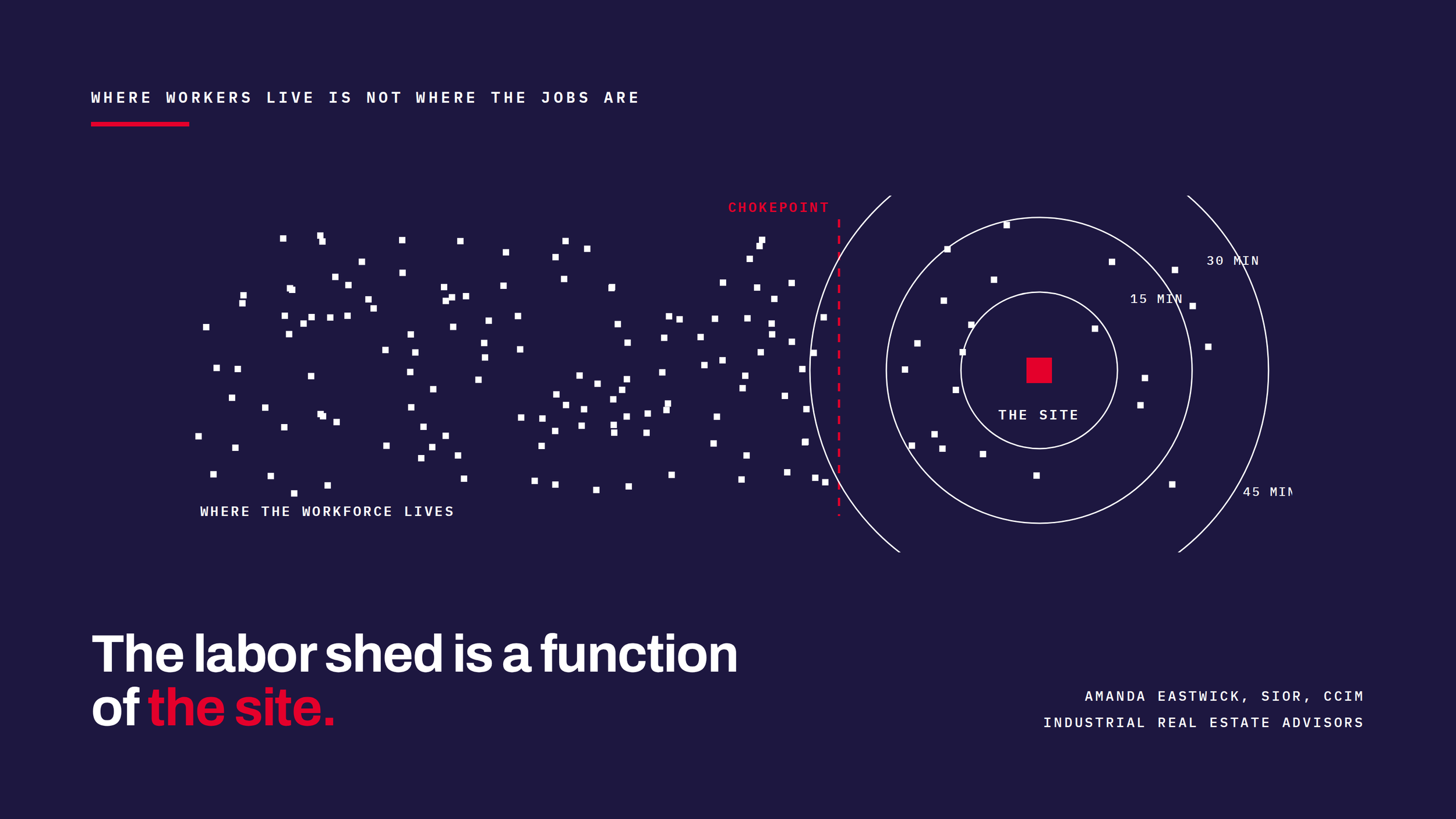
That gap is the labor shed, made visible. The industrial employment cores and the residential cores in this market are different places, connected by a commute, and the length and reliability of that commute is a property-level variable. It is affected by which side of the interchange a building sits on, by how yard and employee traffic are separated at shift change, and by how much of the workforce has to cross a chokepoint to reach the door. Two buildings a few minutes apart on a map can sit on opposite sides of that geometry. This is the level at which labor stops being a market question and becomes a real estate question, and it is why we run this comparison per address rather than per submarket.
THE WORKFORCE THAT EXISTS VS. THE ONE YOU NEED TO RECRUIT
Every industrial market has an existing workforce, employed by companies that were almost certainly not thinking about your operation when they hired them. The relevant question is not whether those workers exist. It is whether your requirement can be met from genuine slack in the market, or whether it can only be met by pulling people away from employers who currently have them, and what closing that gap actually involves.
Where net-new recruiting is required, several variables behave differently than occupiers expect. The scope is how many hires must come from outside the currently available pool, which is a very different number from total headcount. The cost is not the posted wage but the premium required to move someone who already has a job, compounded by the turnover that a premium-driven hire tends to carry. The responsibility question has a different shape than it does with power, because there is no landlord across the table to negotiate it with, but it is not absent: state and regional workforce programs, training grants, and economic development incentives are real, they vary substantially by jurisdiction, and in Nevada and several Western states they are negotiable rather than fixed. The timeline is the ramp curve, meaning how long full staffing actually takes, which rarely matches the construction or occupancy schedule the rest of the project is built around.
Underneath all of it sits a longer-horizon question: whether the pool replenishes. A market can be tight today and still be a reasonable bet if its training pipeline is pointed at the roles you need. Northern Nevada is instructive here too. The same Lightcast data identifies warehousing as the single most in-demand specialized skill in Washoe County, with forklift operation also in the top five, confirming that industrial skills are what this economy runs on. It also counts roughly 9,000 annual graduates across the county’s institutions, led by the University of Nevada, Reno and Truckee Meadows Community College, but the largest credential shares sit in science technologies, health and wellness, and nursing support rather than industrial trades. That is not a criticism of the pipeline, which is producing what it was built to produce. It is an observation that a region’s most demanded skills and its largest credential outputs are not automatically the same thing, and an occupier planning to grow headcount over a ten-year horizon should know which of those two its business case relies on.
We are direct with clients about this: specific wage requirements, applicant flow, and ramp timelines should never be assumed from a general market guideline. They get confirmed for the specific site in question, which is exactly why this step belongs early in due diligence rather than late.
LABOR DUE DILIGENCE BEFORE YOU COMMIT
The occupiers who avoid labor surprises are the ones who ask specific questions, of the specific party actually positioned to answer them, before an LOI, lease, purchase agreement, or build-to-suit commitment is signed. Each party knows a different part of the answer. None of them knows all of it.
Questions for regional economic development and workforce agencies, who see pipeline and program detail no market report captures: What training programs, grants, or workforce funding apply to an operation of this type and size, and what are the actual qualification requirements? What large employers have announced expansions or entries that will compete for the same workers over the next thirty-six months? What has recent hiring experience looked like for comparable operations in this specific submarket?
Questions for existing employers and staffing firms in the submarket, who hold the only ground-truth data that exists: What is real applicant flow per open role at the wage range under consideration, and how has it moved? What is actual turnover, in the first ninety days and annualized? Which shifts fill easily and which do not? How far above posted rates do offers actually land in practice?
Questions for a labor analytics provider or site selection consultant, on the modeling only they are equipped to run: What does the drive-time labor shed around this specific address look like, and how does it compare to the alternatives on the same basis? What does the demographic trajectory look like over the facility’s intended life, not just today? What happens to this location in a tight-labor scenario, in a demographic contraction scenario, and in a scenario where a major employer enters or exits the region?
Questions for the real estate advisor, on how the answers above should shape the decision: How do these sites compare on labor shed, on the same basis, rather than on market-level averages? Which physical attributes of this building constrain the workforce, including employee parking counts, shift-change circulation, separation of employee and truck traffic, and transit access? How should labor risk be reflected in the negotiation, in term length, expansion rights, and flexibility? If the labor picture is uncertain, does that justify walking away from a site that clears every other filter?
These are four different roles, not one, and part of our job is making sure none of them gets asked a question outside its own expertise. Our role is different from all three: to know which questions to ask, in what order, and how the answers should shape the site decision and the negotiation, not to produce the labor analysis ourselves.
LABOR AS A COMPARISON VARIABLE
The Northern Nevada case is specific, but the pattern it illustrates is not. Two markets that look comparable on posted wages can diverge sharply on whether those wages actually buy you people, and two buildings at the same rent in the same submarket can carry very different labor sheds. Neither divergence is visible in a market-level average, which is precisely the problem with using one to make a site decision. This is why we treat labor as a comparison variable from the start of a search, applied across every alternative on the same basis, the same way we treat power or transportation cost, rather than confirming it only for the site that survives every other filter.
One caution worth stating plainly, because it is the same caution the research itself carries: macro-level labor reports are market indicators, not site selection instruments. They are the right tool for framing a comparison and the wrong tool for making a commitment. Site-specific labor analysis is a separate exercise, and it should be run before a decision, not cited after one.
THE LABOR READINESS FRAMEWORK
This is the sequence we use to bring workforce into a site selection process correctly, rather than confirming it after a site has already been chosen. It is not a labor economics methodology. It is a sequencing discipline: operation, requirements, existing pool, site-level accessibility, recruiting implications, then the site decision itself.
Define the operation, not the market. Establish actual headcount, shift structure, skill requirements, seasonality, and the wage ceiling the business case supports, before touring a single site.
Establish the required workforce characteristics. Translate that requirement into the terms that matter commercially: role mix, certification requirements, shift coverage, ramp schedule, and wage band, without collapsing it into one number.
Verify the existing pool, not just the employment figure. Confirm worker concentration alongside the underlying demographic concentration and participation rate, so you understand whether you are hiring from slack or recruiting from incumbents.
Verify accessibility at the site level. Model the drive-time labor shed for the specific address, confirm real applicant flow and turnover at your intended wage, and identify physical constraints in the building itself that limit workforce capacity.
Understand recruiting scope, cost, responsibility, and ramp timeline. Where a gap exists, get it scoped by the parties positioned to scope it, including available workforce programs and incentives, before it becomes a staffing surprise.
Incorporate labor risk into site comparison and negotiation. Weigh it across every alternative on the same basis, and reflect it in negotiated terms, including term length, expansion rights, and flexibility, not just in the final building selected.
WHERE OUR ROLE ENDS, AND WHERE IT DOES NOT
Our role in this process is to make sure labor gets evaluated early, in the right sequence, alongside every other site variable; to coordinate the right parties at the right time; to compare labor accessibility across alternatives on a consistent basis rather than on market averages; and to help structure the real estate decision and negotiation around what those parties find. That includes knowing when a labor question should pause or eliminate a site rather than get resolved after the fact.
What we do not do, and say plainly, is produce the labor market analysis or workforce plan ourselves. That work splits by role: economic development agencies and workforce boards hold program and pipeline detail, employers and staffing firms hold real hiring experience, and labor analytics providers hold the modeling capability. We think that distinction makes the process more credible, not less. An advisor who presents a market-level wage table as site-level due diligence is doing the same thing as an occupier who accepts that a region “has a good labor pool” at face value, taking something on faith that deserves verification.
There is one part of this that is unambiguously ours, and it is worth being clear about, because it is routinely handed to the wrong party. The labor shed is a function of the site, and the site is a real estate decision. Which building you choose, where it sits relative to housing and transit, how many employees can park, whether shift change collides with truck traffic in the yard: those are not workforce planning questions that happen to involve a building. They are building questions that determine workforce outcomes, and they belong in the real estate process from the beginning.
THE REAL ESTATE IMPLICATION
Labor has not become less important in industrial site selection. It has become less visible, which is a more dangerous condition. Power was promoted to the front of the process because it fails loudly and early, in ways a project team can see. Labor still fails, but it fails quietly and late, after the commitment has been made and the options have closed.
The question worth asking is not whether a market has workers. It is whether this site can recruit and retain the workforce your operation actually requires, at a wage your business case supports, on the shifts you actually run, and whether that can be verified before you sign rather than discovered after you occupy. Treating that as a real estate question, and building it into site selection early, is what separates a process built to hold up for the next decade from one that looks fine on paper and runs into a wall eighteen months after occupancy.
If workforce access is a live question in your current site search, lease renewal, or relocation evaluation, that is the right time to bring it into the framework, not after a site has already been chosen.
Labor Belongs in the Site Selection Process From the Start.
Build Your Site Selection Brief
FREQUENTLY ASKED QUESTIONS
If a market report shows a large industrial workforce, is that enough to move forward?
No. That is a starting point, not verification. Employment volume describes who is working today, not who is available to you, reachable from your specific site, or willing to work your shifts at your wage.
What is the difference between labor available in a market and labor accessible to a site?
Regional workforce totals are drawn across an entire metro. Your building recruits from a drive-time radius around one address, and only from workers who are not already committed to another employer. Both filters have to be applied site by site.
What is a labor shed, and why does it matter in industrial real estate?
A labor shed is the geography workers will actually commute from to reach a specific building, measured in drive time rather than distance. It is site-specific rather than market-specific, which makes it one of the few workforce variables that is genuinely determined by the real estate decision itself.
Does a high labor force participation rate mean a market is a good place to hire?
Usually the opposite. High participation means most of the available workforce is already employed, so new entrants are recruiting against incumbent employers rather than hiring from slack, which changes both the cost and the timeline of reaching full staffing.
How do I know whether a market’s workforce pipeline can support growth?
Look at what the region’s training and credential output is actually producing, not just its current employment. A market can carry deep experience in your roles today while its educational pipeline is weighted toward entirely different fields, which matters over a facility’s full life rather than on day one.
When should labor be evaluated in a site search?
Early, alongside power and transportation, and applied across every alternative on the same basis. Confirming labor only for the site that survives every other filter is how labor risk gets discovered after the commitment rather than before it.
SOURCES AND NOTES
Cushman & Wakefield, West Region Industrial Labor Report, Q4 2025. Source for Reno’s warehouse wage index, material-moving and production worker concentrations, target blue-collar demographic concentration, and labor force participation rates, along with the West regional and U.S. baselines each is measured against.
Lightcast, Economy Overview: Washoe County, Nevada. Source for the ZIP-level comparison of employment location against worker residence (2022 employment data), the ranking of in-demand specialized skills, and the credential pipeline figures (2021 graduate counts). Figures are rounded in the text.
Area Development, “The New Rules of Industrial Site Selection,” 2026 series. Source for the sequencing discussion in the opening, specifically the position that workforce now enters the analysis after power, land, and permitting constraints have been cleared.
A note on how these are used. All three are macro-level market indicators, and the two labor reports say so themselves. They are cited here to frame a comparison and to illustrate a pattern, which is what they are built for. None of them is a substitute for site-specific labor analysis, and no site decision should rest on them. Where figures carry a date, that date is stated, because labor data moves and a number that was accurate at publication may not be accurate when you read it.
Amanda Eastwick, SIOR, CCIM, is a Director at Cushman & Wakefield and an Industrial Advisor specializing in occupier strategy, site selection, and lease negotiation across the Western U.S. She is the Founder and President of WILD, Women in Industrial, Logistics & Development. BS.146113