
The case for Northern Nevada
Northern Nevada earns its place on an industrial shortlist on its own merits: logistics reach, business environment, incentives, labor, and room to grow. The case is built on current data, submarket by submarket, and it is governed by the same honesty as our advisory. When Nevada fits, the case is clear. When it does not, you will hear that directly.
Western coverage from a single inland node
The Reno-Sparks-TRIC corridor sits at the junction of I-80 and US-395, with Union Pacific mainline rail and air cargo through Reno-Tahoe International. Less than one day of truck service reaches more than 60,000,000 customers, eight states, and five major U.S. ports serving the Pacific Rim. Two-day service covers 11 states. For a distribution network, that geography is the argument.
Highway
I-80 east-west and US-395 north-south, direct lane access to the major Western population centers.
Rail
Union Pacific mainline service through the corridor.
Air
Air cargo capacity through Reno-Tahoe International Airport adjacent to the Airport submarket.
Reach
More than 60,000,000 customers, eight states, and five major U.S. ports serving the Pacific Rim within one day of truck service. Eleven states within two days.
A 129 million SF market is not one market
Each submarket has its own profile, and matching the operation to the submarket is where site selection actually happens. Select a submarket to read its current quarter.
Storey County / TRIC
| Submarket | Inventory (SF) | Vacancy | YTD Net Absorption (SF) | Asking Rent (NNN, PSF) |
|---|---|---|---|---|
| Storey County / TRIC | 28.8M | 12.9% | +711,249 | $0.75 |
| Sparks | 30.3M | 12.8% | -223,636 | $0.96 |
| North Valleys | 28.3M | 17.9% | -341,823 | $0.85 |
| South Reno | 11.6M | 7.8% | +250,787 | $1.06 |
| Airport | 10.2M | 11.7% | +212,025 | $0.95 |
| Douglas County / Carson City | 7.1M | 7.6% | -76,833 | $0.79 |
| Fernley | 6.8M | 15.9% | -2,000 | $0.60 |
| West Reno | 2.4M | 9.3% | +4,150 | $0.80 |
| Hwy 50 Corridor | 2.3M | 9.7% | +20,800 | $0.55 |
| Central | 1.9M | 1.9% | +47,293 | $1.02 |
| Market Total | 129.8M | 13.0% | +602,012 | $0.84 |
Reading the quarter: the Q2 story is supply timing. The market posted 196,938 SF of net occupancy growth, bringing the year to 602,012 SF, with Storey County and North Valleys accounting for roughly 70% of quarterly leasing at 1.7M SF. Vacancy still ticked up 10 bps to 13.0%, almost entirely on the vacant delivery of 334,800 SF at 1050 Waltham Way in TRIC — supply timing, not softening demand. YTD leasing of 4.9M SF runs 37.4% above the five-year quarterly average. The read for occupiers: demand is not the problem, and the vacancy on the board is leverage for tenants who move before it tightens.
A building without a workforce is a liability with dock doors
Reno's industrial labor base runs deeper than the market's size suggests. The region holds a population of 590,000, projected to grow 4.9% over the next five years, with a working-age population of 361,000. Industrial occupations are a structural strength: roughly 16,500 material-moving and 17,700 production workers as of 2024, with worker concentrations well above the West region average (1.5 versus 1.2 in material moving, 1.1 versus 0.9 in production) and projected occupation growth of 5.0% and 4.2% respectively. Warehouse wages average $24.52 per hour across the four benchmark positions, with production at $24.80.
Labor availability is evaluated as part of every site decision through the Labor Availability Framework: labor force depth by submarket, wage positioning by role, commute sheds, and the competitive employer landscape.
Evaluated against your operating profile, not assumed
GOED Programs
Nevada GOED offers abatement programs for qualifying relocations and expansions, which can include sales and use tax abatement, modified business tax abatement, personal property tax abatement, and real property tax abatement in certain qualifying cases. Eligibility, terms, and approval vary by project and GOED's requirements.
The Discipline
Incentives are modeled against your actual operating profile. A program that looks compelling in a brochure may be immaterial to your P&L, and occasionally the reverse.
Tax Structure
No state personal income tax, no corporate income tax, and a modified business tax structure, stated as facts about operating in Nevada.
Entitlements
Permitting and entitlement timelines in the industrial submarkets vary by jurisdiction, site status, infrastructure, and utilities, and are evaluated on a project-by-project basis as part of every site selection engagement.
Product, land, and infrastructure
Modern bulk and manufacturing product, entitled land for build-to-suit at TRIC and Fernley, and continuing infrastructure investment across the region's industrial submarkets.
The framework behind the decision
Labor, power, transportation, utilities, entitlements, and incentives evaluated as one decision framework. Power availability is now a site selection variable, not an afterthought.
How site selection runsFor relocating and expanding businesses
These organizations are the on-the-ground ecosystem for a Nevada move, and they are good at what they do.
We are not just presenting a market. We are welcoming you to our hometown.
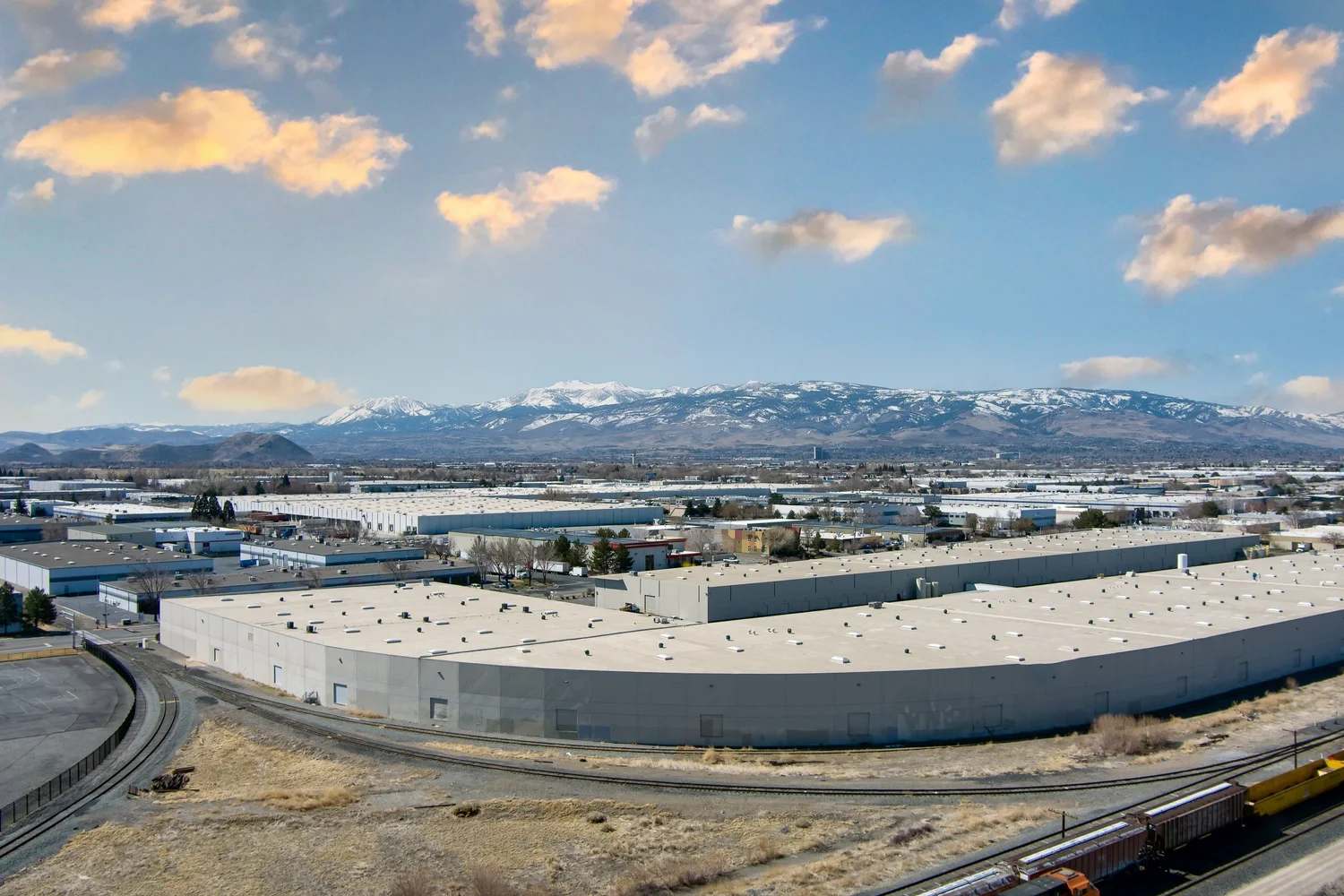 Boots on the Ground · Northern Nevada
All three advisors on this team are native Nevadans. We learned this market by living in it: the submarkets, the commutes, the people who make the region work. The statistics make the case for Nevada on its own merits. We are the part that comes after the statistics, a team that represents this region because we love it, and we want the companies that choose it to be glad they did.
If Nevada is on your shortlist, or should be.
The next step is a conversation grounded in your operation's numbers: the Site Selection Framework applied to your labor profile, freight lanes, power needs, and capital plan. And if the analysis says Nevada is not your answer, that is what you will hear.
Start a Conversation