When a Relocation Question Becomes a Business Strategy Problem
What it actually means to work with a fully integrated platform and why it changes the outcome.
Most owner-users don't start with a relocation question.
They start with a cost problem. A labor problem. A regulatory environment that no longer makes sense for their operation. Something in their current model that isn't working the way it used to, and a growing sense that the answer might involve moving.
That's when they call a broker.
And that's exactly where the advisory experience either expands to meet the decision or falls short of it.
Here's a scenario I see regularly with industrial owner-users.
A Southern California manufacturer owns their building. Rising operating costs, tightening labor supply, and California's regulatory environment have their CFO asking a question they haven't asked before: what would it actually cost to relocate, and what would we walk away with if we sold?
On the surface, it looks like a real estate question. It isn't.
It's a supply chain question. A labor question. A capital question. A tax question. A facilities question. A business strategy question that happens to have real estate at the center of it.
The problem with handing that question to a broker who only does leasing is that you get a leasing answer. You find out what's available in Reno or Phoenix or Salt Lake. You get shown buildings. You might even get a deal done. But you don't get the full picture. And in a decision this size, the gaps in the picture are where the real costs hide.
What a Fully Integrated Platform Actually Changes
Transportation and labor typically account for up to 75% of total operating costs for an industrial operation. That means the location decision, before a single lease term is negotiated, is already determining the majority of what this move will cost or save long-term. Getting that decision right requires more than real estate expertise.
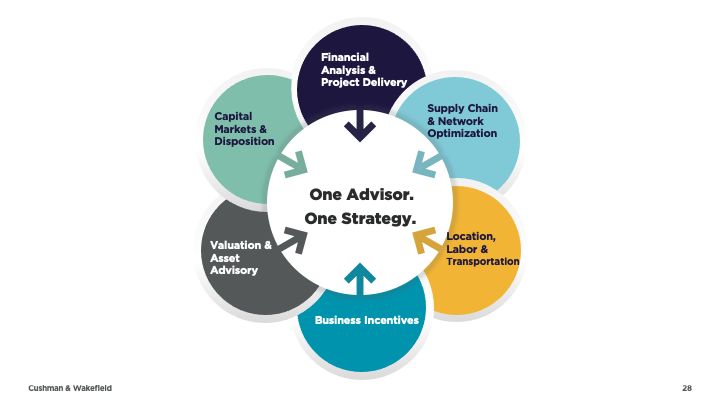
When I work with an owner-user evaluating a Western U.S. relocation through the Cushman & Wakefield platform, the engagement runs through a single point of contact who coordinates across every relevant service. One advisor. One strategy. Everything connected.
The scope of a comprehensive engagement varies by client and situation. The services described here represent those most commonly engaged in an owner-user relocation scenario. The full platform extends considerably beyond this scope, and the right combination is determined specifically by each client's objectives and the complexity of the decision. Each service is engaged independently based on need.
Whatever it is, the way you tell your story online can make all the difference.
Supply chain and network optimization. Before evaluating a single market, analysts map the full sourcing and delivery landscape, including facility size, headcount, material handling systems, transportation costs, and distribution network design. The output is a data-driven shortlist of optimal market locations, not a list of available buildings.
Location and labor analytics. Labor is evaluated across more than 60 quantitative and qualitative factors, including workforce stability, competitor wage analysis, commuter patterns, long-term viability, and skill availability for the specific operation. This analysis runs in sequential phases from broad market comparison down to field validation with local employers. The companies that skip this step often discover the labor problem after they have signed.
Transportation study. Interstate access, proximity to intermodal rail yards and ports, parcel carrier hubs, and last-mile implications are all evaluated. For a manufacturer, transportation cost can be the single variable that makes two otherwise identical markets look very different on a total cost basis.
Business incentives. A dedicated incentives team assesses, negotiates, and administers local and state economic incentive packages, which may include cash grants, tax abatements and credits, utility rate reductions, employee recruiting and training assistance, and expedited permitting. The negotiation does not stop at closing. Compliance and administration continue through the life of the agreement to ensure the full value is captured.
Valuation and advisory on the existing asset. A sound relocation decision requires an independent assessment of what the current California facility is actually worth in today's market. That number anchors the entire financial model and directly informs the disposition strategy. Engaging valuation early, rather than after a decision has already been made, protects the client from building a business case on incomplete information.
Capital markets and strategic disposition. Selling a California industrial asset is not simply listing it. A strategic disposition, positioned to the right buyer pool at the right moment in the cycle, produces a fundamentally different outcome than a reactive sale under timeline pressure.
Financial analysis. As locations are evaluated, a parallel financial analysis compares total cost of operations at each site, modeled on both a cash and P&L basis. The output is a board-ready deliverable built for executive decision-making, not a broker's opinion of value.
Project and development services. Eighty percent of a project's potential cost savings are identified in the early planning phase. For clients requiring a significant buildout, having project management integrated from the start, rather than brought in after the deal closes, is where that value is protected.
The services outlined above represent those most relevant to this type of engagement. Not every relocation requires all of them, and not every service is included in a standard advisory relationship. The right scope is defined by the complexity of the decision, the client's internal capabilities, and what the situation actually requires.
What does not change is the model. One point of contact. One coordinated strategy. Every workstream is talking to the others rather than operating in isolation.
The companies that navigate complex relocations well are not simply the ones who found the best building. They are the ones whose advisors treated the real estate question as what it actually was, a business strategy question, and built a response capable of answering it completely.
That is what a fully integrated platform means in practice. An advisor who knows how to deploy the right resources at the right stage, keep the strategy connected across every workstream, and never let the real estate answer get ahead of the business decision.
If your company is asking the relocation question, that is the right time to have this conversation.
Amanda Eastwick, SIOR, CCIM is a Director at Cushman & Wakefield and West Coast Industrial Advisor specializing in occupier strategy, site selection, and lease negotiation across the Western U.S. She is the Founder and President of WILD, Women in Industrial, Logistics & Development.
industrialrealestateadvisors.net